Showing posts with label real estate. Show all posts

Wednesday, November 27, 2013

Reporting the trend or creating it?

The following article in the Vancouver Sun illustrates how younger generations differ from previous ones on how they want to live in and around Metro Vancouver.  Stories such as the one below are regularly published describing the current trend in housing and often cite experts from the real estate industry to back up their stories.  It's as if the story itself is creating the current trend being capitalized on by the real estate industry.  Or is it just a reporting of what has already been going on? You can decide for yourself.

Vancouver Sun article below:


VANCOUVER — With a shrug that amounts to a tectonic demographic shift, millennials – especially in Metro Vancouver – are rejecting their parents’ suburban commuting lifestyle in favour of “live/work/play” neighbourhoods. If developers continue to meet this demand, and with the Canadian economy strengthening, all systems are go for 2014 to be a boom year in Canadian real estate, according to the recent Emerging Trends in Real Estate report by PwC and the Urban Land Institute.
Millennials, a.k.a. Generation Y (those born in 1981 and after), are driving the overwhelming shift to urbanization, says John Bunting, partner at PwC. They “want to live in places where it’s easier to get to and from. They want to live where their buddies are. They want to be in neighbourhoods where the restaurants are good, where they can eat and drink and be entertained.”
The key is that they’re going where their jobs are. “That has a significant amount to do with it,” says Bunting. “There’s a shift in demographics from boomers to Generation X to Generation Y. Generation Ys don’t want to live the lives their parents and grandparents did.
“Twenty to 30 to 40 years ago, someone in their 20s would think, ‘It’s time to start my career, get a good job, get married, buy a house, have kids.’ [At PwC] we hire about 80-90 young people out of school every year. This doesn’t always occur to them – their values at this age are different than previous generations.”
Their values may be partly shaped by a pragmatic grasp of reality: Right now land is just too expensive. “There’s a joke that if you’re in Vancouver, you get in your car and head east until you find a neighbourhood you can afford,” says Bunting. “We’re running out of dirt to build on. Developers’ biggest challenge is to find affordable real estate. Accessing a large land bank is a challenge for them. The marketplace could take more development. It’s a matter of finding cheap land.”
Failing that, millennials will keep seeking out transit-oriented developments like Blackwood Partners’ Renfrew Centre, at East 12th and Renfrew, scheduled for 2015 completion. Being next to both the central SkyTrain station Renfrew and the 99B bus line loop, the 170,000-square-foot office building matches other current transit-corridor developments – but it also one-ups them. It’s right on the 24-km Central Valley Greenway bike path connecting Vancouver to New Westminster.
Ten years ago, Renfrew was mostly residential. Transformed into mixed use, “it’s a great place to work where you don’t have to commute to downtown,” says Jonathan Button, Blackwood’s senior vice president, asset management and operations. “It’s easier to go to work where you live. We see it happening all over the Lower Mainland.”
Blackwood’s Central City, in Surrey, with 640,000 square feet of retail, a 340,000-square-foot Simon Fraser University campus, and 550,000 square feet of Class A office space, is becoming another self-contained neighbourhood. “It’s another example of a suburban node that’s becoming more urban. It’s by Surrey Central SkyTrain station, with the new City Hall close by, and the new Surrey Central Library across the street.”
Vancouver is ahead of other cities in reducing the need for long car commutes, Button says. “I see it being more on people’s minds in Vancouver, with people thinking about it, talking about it. It’s partly because of Vancouver’s more outdoors-focused lifestyle and culture. It’s more possible there to cycle year-round. And there’s a great transit system.”
Still, the same job-centric, urbanizing trend is happening in colder places like Calgary, says Bunting. “The mayor there has put on hold a number of so-called suburban developments. He’s encouraging more density. There’s a ton of building in the downtown. It’s a real challenge for a city and province to service huge suburbs with schools, fire departments, city servicing, policing.”
Bunting points out, “In Canada, we’re so spoiled by the landmass. We’re accustomed to the stereotypical North American dream: You own a piece of dirt, a big house, two cars. In Europe they’ve had densification for a long time. We’re catching up.”
Bunting chuckles at the memory of a colleague who moved from Paris to Toronto with his wife and three kids. “They found a house in a nice neighbourhood: a 2,300-square-foot split. I said to him, ‘It must be tough to stuff your family into 2,300 square feet.’ He just looked at me. In Paris, they lived in a 1,500-square-foot flat! They thought that was normal.”
According to the Emerging Trends report, many longer-term workforce members are adopting the millennials’ minimal-commute preferences. “Intensification of downtown areas of cities is continuing in Canada’s major centres to combine with reverse migration from the suburbs to downtown areas as one of the most forceful and rapidly emerging secular trends in both corporate office and residential real estate.”
The report will be the subject of a ULI conference on Tuesday, 8-9:30 a.m. at the Vancouver Convention Centre. Conference Chair Jeff Brown says, “There’s definitely a lot of information in the report about the large macrotrend that’s happening in North America and elsewhere on the planet: the flight to cities. We know that people are moving into cities for economic, as well as environmental and sociological reasons. At the event, we’ll be examining the macrotrends and also examining the microtrends that the players are dealing with.”
Also to be discussed: financing options. “With interest rates forecast to rise in the next couple of years, are we going to see some of the existing participants change their behaviour slightly? How are these acquisition and development projects being funded?
“Attention is being focused on the key markets. The [report] interviews show that there are actually quite distinct areas in North America attracting investment capital. These are gateway cities into the global economy,” says Brown, who’s also development and acquisitions manager at Shape Properties.

Thursday, May 9, 2013

Article on condo report misleading

The Burnaby NewsLeader article's report on a report to quell fears about foreign ownership of BC property has failed to focus on a key issue related to foreign ownership .  Just a note: I tend to include non-resident Canadians (residents of other provinces and territories) in the same category as foreign ownership which is unlikely to have been considered in the report below.

When talking about unoccupied condos, the report fails to either acknowledge the existence of occupied condos owned by foreigners or has failed to separate them from occupied condos owned by non foreigners (BC residents).  The issue is not only about unoccupied condos but also about foreign-owned condos that are indeed occupied.

Questions that need to be asked include:

  1. How many of the occupied condos are owned by foreigners?
  2. How does the reporter know if the dwelling is occupied by the owner or by a renter? 
  3. How does the report find out whether or not the occupant is a foreigner/non-resident or a Canadian resident of BC (unless the reporter works for Canada Immigration)?  The Census data is far from accurate as there is no way to scrutinize the information for accuracy.
Such reports often use unreliable statistics because the numbers themselves are incomplete, rendering the report unreliable and misleading.

What is most interesting about this issue is that no political party wants to talk about the issue of non-resident ownership of BC real estate.

No evidence of glut of unoccupied condos: report


Fears that foreign buyers and other temporary residents are snapping up an abnormal share of Metro Vancouver condos aren't borne out by statistics, according to a new analysis.
Urban Futures researchers examined 2011 Census data and found just 0.8 per cent of all homes in the Metro region and 1.4 per cent of apartments are occupied by foreign or temporary residents.
Vancouver and West Vancouver were above average at just under two per cent, while other larger cities in the region had fewer foreign or temporary apartment dwellers, including Richmond at 1.3 per cent, Burnaby at 1.1 per cent and Surrey at 0.4 per cent.
There had been media reports earlier this year that up to a quarter of condos in certain parts of downtown Vancouver are either unoccupied or occupied by non-residents, prompting renewed concern that wealthy foreign investors are parking money here.


Some observers warned of the rise of ghost neighbourhoods that look dense but don't have enough active residents to create a vibrant community.
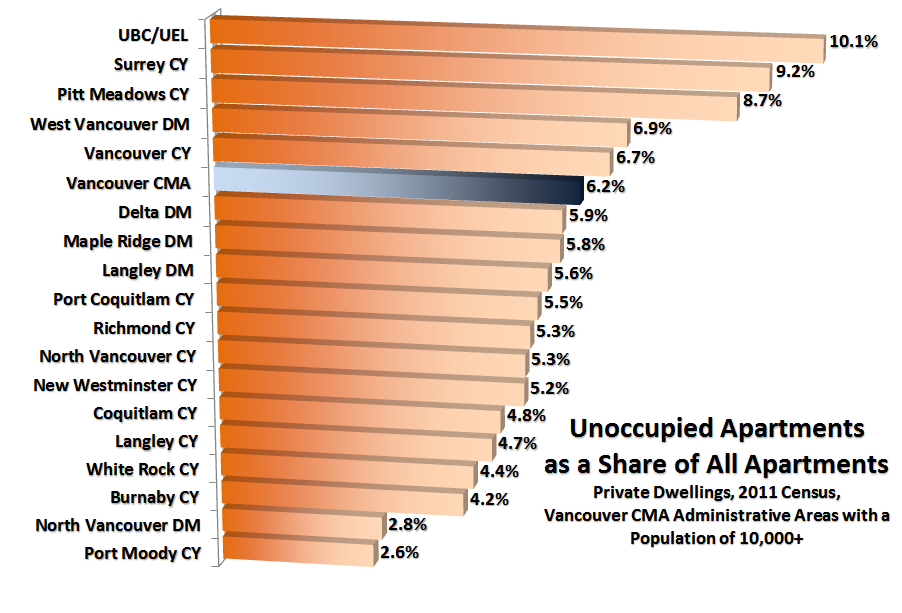
Urban Futures found 6.2 per cent of Metro apartments were unoccupied – below the national average – and said there's no basis to conclude that's excessive.
The areas with the highest levels of unoccupied apartments were UBC at 10.1 per cent, Surrey at 9.2 per cent, Pitt Meadows at 8.7 per cent, West Vancouver at 6.9 per cent and Vancouver at 6.7 per cent.
"Much ado is being made about nothing when it comes to the prevalence of foreign and/or temporary residents and unoccupied dwellings in this region," the report said.
It noted temporary residents include large numbers of students – there are 250,000 post-secondary students enrolled across the region who would represent the third largest city if they were clumped together.

Thursday, December 6, 2012

Why is real estate so expensive in Metro Vancouver?

This is not meant to be a political blog but sometimes I need to let out my beliefs when something hits a nerve.

According to a Burnaby NewLeader article below, Burnaby has the third highest real estate prices in Canada. What is the reason behind such high real estate prices in Burnaby and Metro Vancouver?

Politician's Answer

If you ask provincial politicians, they will tell you that land values in Metro Vancouver have remained among the highest in North America because of things like immigration, overseas investment or the fact that Metro Vancouver is such a wonderful place to live because it is arguably one of the most diverse regions in the world.  Ask a real estate agent and you will receive the same cookie-cutter, rah, rah, rah answer.  If you ask someone that is really creative, they will tell you that it is a combination of the above factors along with other economic factors that has led to Metro Vancouver having such "valuable" land.  Don't get me wrong, the above reasons ARE  factors in making property values higher but there is more to it than what the "experts" are always parroting.

What BC politicians will never tell you about high property values in Metro Vancouver and elsewhere in BC is the fact that property tax rates for residents and non-residents* are the same in Metro Vancouver, allowing non-residents to use Metro Vancouver real estate as a shelter/hedge for their accumulated cash against anticipated foreign currency price fluctuations.  This is true for locals who own secondary properties aside from their primary residences and pay the same rate as non-locals who own multiple properties.  They pay the same rate on non-primary properties.

* Note: "non-resident" refers to those either not living in BC or not living in Canada altogether.

A simple counter argument to the tax-rate argument is that there currently already is a higher property tax rate on properties that are not the primary residence of the owner.  This difference is not only minuscule in comparison to the primary-residence rate, but even that can be overcome by having a non-primary residence address registered as a primary residence of a family member such as a spouse or offspring.  Taken even further, non-residents of BC are easily able to own real estate and falsely report a BC property as their primary residence allowing them to pay the same tax rate as BC residents.  The fact remains that non-residents pay the same rate as residents.

Real Estate Stock Market

The best part, for such speculators that do not want to go through the minor hassles of registering multiple homes under different family members or pretending to live here, is the fact that the tax rate difference between primary and non-primary homes is small enough to not even worry about it.  It is not unheard of for wealthy non-residents to buy up as many as ten homes in one swoop and sit on those empty homes while they pay a small fee to have them maintained while they sit empty.   Those empty homes, not being in either the real estate or the rental market, put artificial upward pressure on Metro Vancouver real estate prices, leaving locals to compete for a smaller share of the real estate pie, whether they are buying or renting, with earnings made locally at rates that have not kept pace with rising real estate prices, putting further upwards pressure on whatever little is left in the local real estate market.  Look at high-rise towers throughout Metro Vancouver in the evening from 6pm to 10pm and you will see many darkened spaces, sometimes as many as half are darkened where units are unoccupied but owned by someone.

What does this mean for Metro Vancouver residents?  Actual residents of Metro Vancouver that really live in BC and earn BC wages are subject to property price manipulations in Metro Vancouver as non-BC speculators drop large sums of their cash (earned from outside of the BC economy), placing upward pressure on property values.  We have essentially been subject to our BC Governments having allowed our real estate market to become a manipulated stock market.  This has been allowed to happen under the watch of BC Governments, regardless of party affiliation.  Why has this not been identified as an issue?  Is it because politicians don't want to make an effort to solve a complex problem or is it because they are not smart enough to identify it as a problem?  I believe the truth lies somewhere between the two possibilities depending on which politician you ask.

The well-being of locals that earn local wages is negatively impacted by competition from non-locals that have accumulated their cash in economies outside of BC's.  Such negative impacts are felt locally with the need for affordable housing being an important topic for Metro Vancouver today.  If we ask our politicians, past and present who have or are currently making a career out of so-called issues while ignoring issues that directly effect the economic well-being of local taxpaying residents, why they have failed to correct a problem that has existed over the span of their political careers, I wonder what their answer would be?  I don't believe that any politician has ever been directly asked about non-resident ownership, and believe that they have been given a free pass on this issue while we continue to get bombarded in the media about positive annual reviews about Vancouver's high livability ratings.  Why is an inequitable property tax system not an issue considering the efforts provincial and federal governments make to protect Canadian corporations from foreign takeovers while individuals are left to their own devices at the residential real estate level?

No Money for Transit Improvements

We are continually told that local residents must seriously consider paying property tax levies or road tolls to pay for transit and road infrastructure improvements but are continually ignoring the wealthy non-resident property owners that pay a relatively nominal investment fee known as a property tax.  There needs to be a benefit for all locals rather than just the benefits that some locals have gained by speculating in higher real estate prices spurred by non-local investment.

The answer to propped up real estate prices which negatively impact local residents can and should be a an exponentially higher tax rate for non residents compared to local residents, regardless of whether it is a primary or non-primary residence.  How would politicians figure out who actually lives here or not?  If they do not already know how to determine this, our problem is much greater than the public thinks considering how many non-residents are benefitting from and draining public services that are meant to benefit local residents and NOT non-residents pretending to live here.  What have our decision-makers been doing all these decades while earning great salaries and life-long pensions?  The unasked, unanswered questions continue to exist while our politicians come and go with their high salaries and gold-plated pensions at the public's expense.


Burnaby NewsLeader - News


Burnaby the third most-expensive real estate in Canada: study


Burnaby is the third-most expensive market in Canada to buy a home after Vancouver and Richmond, according to a study by Coldwell Banker Real Estate.


The study looked at Coldwell Banker’s average listing prices of four-bedroom, two-bathroom properties on its company website between January and June of this year.


In Burnaby, the average price for the company’s listings was $917,968, after Vancouver’s $1.87 million and Richmond’s $1.18 million.
Burnaby was well ahead of fourth place, Oakville, Ont. at $745,000. The most affordable city in the study was Windsor, Ont., with an average listing price of $170,991.
Arthur Ng, manager of Coldwell Banker Westburn Realty, said Burnaby’s popularity with home buyers is due to its proximity to Vancouver and its central location yet being relatively more affordable.
“I think people are realizing, I only have so much money and I don’t want to be out in the boonies,” Ng said.
Richmond’s market is more influenced by Asian buyers, specifically those from overseas.
But Ng said those buyers aren’t just investors and speculators.
“That’s what the misconception is. I wouldn’t call it an investment ... Their kids are going to school [here] so they buy properties for them and they have plans to retire here, and many of them have come to retire here.”
Ng said many overseas Asian buyers have bought here and set down roots, planting their families, attracted by the stability of Canada, but with the breadwinners sometimes continuing to work back in their home countries.
They often settle in Richmond because they feel at home with its many Asian shops and restaurants.
“Of course the prices now are so high there so that’s why now they’re coming to Burnaby,” which has its own share of Asian shops and services, said Ng.
In recent months, after the study period, Ng said his company’s Burnaby list prices (as opposed to sale prices) have dropped by five to eight per cent.
“People are realizing that, the market’s slowing down, if I need to sell I need to adjust my price in order to get some activity on it,” Ng said.
“But by no means are we seeing a fire sale.”
As for whether prices will drop further, he believes that’s unlikely since most people are living in or renting out their homes.
In the United States, people are scrambling to sell to get out of the market after becoming victims of too much speculation, he said.
“But no one here sells their principal residence for no reason just because the market is bad.”
Prospective buyers who have been holding off waiting for prices to drop further are starting to see there are no drastic reductions likely and are jumping back into the market while interest rates are still low.
“We’re seeing a bit of a turnaround already now.”
In 2008 and 2009, local real estate prices dropped by 20 to 25 per cent “but it came back like wildfire within nine months. That was a global collapse, we’re not in a global collapse now.”
Ng predicts prices will continue to go up, but more gradually than in the past when 10 to 20 per cent jumps were common. Instead, in the next few years he sees prices rising two to five per cent annually.
Those larger increases simply weren’t sustainable, he said, but the Lower Mainland continues to be an attractive place to live, drawing upwards of 60,000 new people to B.C. each year which helps fuel the local housing market.

twitter.com/WandaChow


Burnaby NewsLeader - Opinion

COLUMN: Burnaby must do more for the homeless


Burnaby does a great job helping to provide social housing.


For most people of modest means, living with a disability, elderly—or all three—there is a decent array of options. It could always be better, of course, but in general this city's got it covered.


And the City of Burnaby deserves credit for working with developers, the province, Ottawa and local non-profit agencies to help that happen.
But where it falls short is with the city's most vulnerable people. The homeless.
As many will know, there is no permanent shelter for the homeless in this rapidly growing city of 225,000 people. Vancouver, New West, Surrey, Langley, Maple Ridge and the North Shore all have shelters, but not Burnaby.
The only option is during a few months of the year when a local church opens its doors and staff from the Lookout Emergency Services Society operate an extreme weather shelter. And it's only open on nights when weather is severe enough that it can create a higher health risk to homeless people.
So for the rest of the year in Burnaby people can be found sleeping in Central Park, tenting in the forest behind Discovery Park, and using the washrooms at the McGill branch as though they are their private bathroom facilities.
Or they're forced to go to Vancouver. Or New West, or one of the growing host of cities working to fill this vital piece of the housing continuum. The Greater Vancouver Shelter Strategy website shows more than two dozen shelters for the homeless in Vancouver, depending upon the time of year. Many are year-round. In New Westminster, a city of 60,000, there are four.
Burnaby doesn't do permanent shelters.
Why? To prove a point?
Mayor Derek Corrigan says housing is not a municipal responsibility, and under his leadership the city has stood its ground on the issue.
In interviews, he's called the practice of giving people a bed indoors for the night, then pushing them out the door in the morning “ridiculous social policy," that distracts from dealing with the core issues of why these people are on the street in the first place.
He points to provincial government policies that have cut people off welfare, closed mental health institutions and increased the child poverty rate. He points to the fact that until recently, B.C. had the lowest minimum wage in Canada.
And he's also criticized Ottawa for all-but ceasing to fund social housing 20 years ago.
And those are all fair comments. They really are.
But in the '90s when Ottawa drastically reduced funds for health care, social programs and infrastructure did the provinces and cities just hold the line on everything to make a point? No, because some things are essential.
Back in 2006, the provincial government put a call out to cities. They said if you put up a piece of land and waive the development costs, we'll build and fund new housing for the homeless.
Eight cities responded. Vancouver put up 14 sites. Cities such as Surrey, Maple Ridge, Abbotsford and Kelowna also put up sites.
Where was Burnaby?
Why is a city with almost $600 million in reserves—one of the richest municipalities in Canada—doing nothing?
Corrigan says it's a slippery slope: Look at Vancouver's rising property taxes, he says—aren't they exceeding their mandate at residents' expense?
That's a red herring. Burnaby can afford to take the risk. It can make a start by offering a single piece of land, maybe even with a building on it. Near Metrotown, at the edge of an industrial area, near the SkyTrain line.
It's time for a permanent shelter in Burnaby.
This city must do its part.
• Chris Bryan is editor of the NewsLeader.