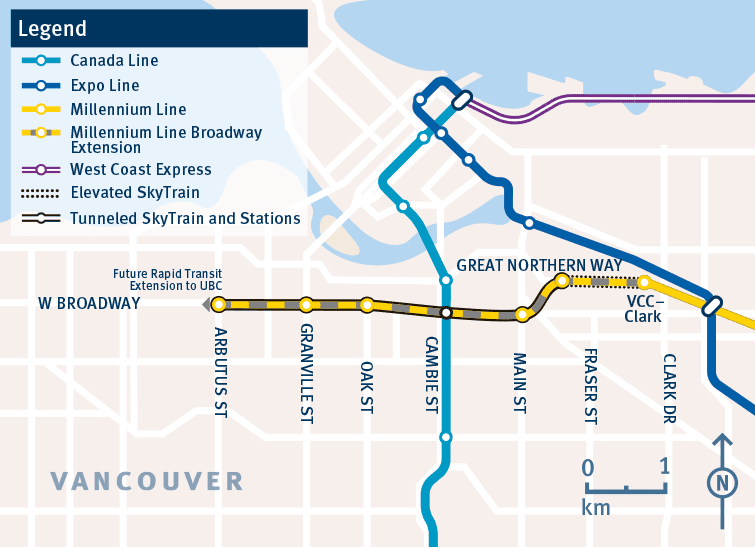
After years of funding delays, TransLink currently has secured funding to extend the line Millennium line from VCC Clark to Arbutus only as UBC has been unwilling to contribute to the extension to UBC... until now. CBC article below.
TransLink has revealed the route for the future Broadway Line extension to Arbutus Street. By choosing to extend it from the Millennium Line from VCC Clarke instead of starting it at Commercial Broadway, TransLink has made the right decision. It would not have made any sense to start tunnelling from Commercial Broadway when they could save hundreds of millions of dollars by beginning the tunnelling further west at Main Street. Now time will tell if there is an appetite to just go ahead and continue the extension past Arbutus all the way to UBC sooner than later.
Broadway line will be an extension of the Millenium Line from VCC Station to Arbutus Street
CBC NewsPosted: Jan 17, 2017 10:32 AM PTLast Updated: Jan 17, 2017 12:53 PM PT
TransLink will begin public consultation in late January on two new train lines planned for Metro Vancouver, the transit authority announced today.
Consultations on the Broadway extension of the Millennium Line will begin Jan. 28.
Consultations on the Surrey-Newton-Guildford LRT project will begin Jan. 24.
The regional transit authority also says it will be doubling SeaBus service on Sundays and holidays and adding more frequent service at peak times on the Expo, Millennium and Canada lines as part of the first phase of its 10-year plan.
TransLink CEO Kevin Desmond said the service improvements announced today are the first of many the transit authority plans to roll out every three months for the next few years.
Vancouver Mayor Gregor Robertson said the plan is the biggest investment in regional transit since 2009, when the Canada Line was built.
"This is really comprehensive improvement around the region," Robertson said. "That's why the mayors supported it so strongly, because it will make a difference in every community across Metro Vancouver."
Millennium Line extended out Broadway
The Broadway Extension will extend the Millennium Line from its current VCC endpoint southwest to Broadway and Main, and then west to Arbutus Street.
"Will rail eventually get to UBC? I'd say that's probably a good chance," Desmond told reporters at a press conference Tuesday. "When? I don't know. But for now, we need to get to Arbutus [and] relieve a lot of crowding on the bus service."
Robertson said the Metro Vancouver Mayors' Council's 10-year vision does include the possibility of extending that line to UBC, but planning would not begin until near the end of that 10-year vision.
As we get closer to the upcoming vote on the TransLink Referendum, Metro Vancouver taxpayers will be required to vote on whether or not they want to pay more taxes in the form of a half percent increase in the Provincial Sales Tax. In a region where housing costs alone have soared out of control leaving wages in the dust, it is going to be a hard sell.
I am not alone when I say that I have a problem with the underlying principle behind transit funding when compared to the underlying principle behind road funding.
Let's be clear; I am in favour of increasing rapid transit and bus service in the region. A well developed transit system (which ours is not) is something that Metro Vancouver and the Fraser Valley needs. I have no problem supporting increased funding for transit. However, the TransLink Executive that consistently squanders hundreds of millions of dollars is making it difficult for people to support giving TransLink more money to squander. The current turnstile debacle is one prime example (of many prime examples) of how incompetent the TransLink Executive is. But back to the underlying principle.
Why a referendum for transit funding when road expansion does not require referendums?
The BC government has recently announced a bridge replacement for the Massey Tunnel at taxpayers' expense without a referendum. The bridge will benefit the billion dollar shipping and trucking industry but the average taxpayer will foot the bill. Likewise, increased transit funded by taxpayers will benefit the shipping and trucking industry in the form of less traffic on the roads for container trucks using those roads. Why is it that public road expansion requires no referendum and a seemingly endless supply of funding but public transportation does not get even close to the funding that road building gets and now we need a referendum to decide if our public transportation system can receive a little bit more money to help it along?
Can we expect a better, well reasoned option to expand a needed transit system than what is currently being presented by our decision-makers? Obviously the people in power are unable to provide better and we as taxpayers are obviously unable to vote better. So here we are. We have a region where the population will increase, resulting in more commuters driving cars all while our decision-makers continue to argue about the details. Unfortunately with this referendum, we are voting on the better of two undesirable outcomes. So here we are. And which is better?
Why voters in Burnaby should vote "Yes" in the referendum
The areas that have little to no transit options are the sources of the traffic congestion in Burnaby. Commuters from under-serviced regions like Surrey and Langley need a rapid transit system that connects into the existing Millennium and Expo lines running through Burnaby. A prime example of non-Burnaby cars clogging Burnaby roads is the Port Mann Bridge and Hwy 1 expansion that has resulted in massive local traffic congestion on Canada Way as car commuters are avoiding the tolls on the Port Mann Bridge in favour of using the un-tolled Pattullo Bridge. Had rapid transit been part of the Port Mann Expansion, we would not have been required to spend as much then as we do now. Regardless, expansion of the rapid transit system connecting into the existing SkyTrain lines from outside Burnaby will significantly decrease automobile traffic running through Burnaby as a viable commuting alternative.
TransLink Executive must be fired
It would be great if a "Yes" vote also meant that the current TransLink Executive is removed. But that would require admitting that a lack of integrity exists among those that spend our money and make decisions on our behalf. I would love to be able to tell the execs that they are fired. Only in my dreams.
A "Yes" vote may get us part or all of the following but a "No" vote will definitely get us nothing more than what we already have which isn't much considering the growth path Metro Vancouver is on.
In his editorial to the Vancouver Sun (below), Bob Ransford explains the importance of timing when asking questions regarding transit planning and the problem of not asking the right questions. Focusing on the "UBC Line" which had been receiving much attention recently, Ransford concludes his piece by pointing out the differing approaches to development between Burnaby and Vancouver around the stations along the Millennium Line.
The number of stations would have a huge impact on the shaping of neighbourhoods along the rapid transit line
By Bob Ransford, Special to The SunDecember 8, 2012 5:06 AM
Now that Vancouver city council has decided that a $2.8-billion subway rapid transit line to UBC is the best way to meet the growing public transportation demand along the Broadway corridor, some hard questions need to be asked.
Why ask the questions after the decision has been made?
Well, if history is our teacher, we should know that securing a political commitment to finance a transit project close to $3 billion is a near-impossible task. I can almost guarantee we're facing at last five years of wrangling over transit governance, regional planning priorities, provincial participation, tax policy, cost sharing and a myriad of other issues standing in the way of finding the money. While that wrangling is going on, there will be lots of time for asking and answering questions.
Second, if a miraculous agreement can be reached to secure $3 billion to build a single transit line in a region that needs at least double that amount of money to finance a short list of other transportation priorities, our attention will then turn to another two to three years of serious planning.
It's during this serious planning phase that we can't afford to ignore asking the serious questions and answering them honestly and completely.
These are the serious questions that went unasked and therefore unanswered during the dysfunctional planning that led to the construction of the Canada Line. That's why, more than seven years after the Canada Line station locations were planned, not a single new housing unit along this high capacity transit system has been built in Vancouver. It's also why at least three and perhaps as many as five transit stations are missing on the line. It's why the system was designed with small station platforms, inhibiting expansion of trains to accommodate increased ridership.
These questions weren't asked because all the attention focused on seeking consensus on raising the money to build the system. When a tenuous agreement among a long list of partners was reached to fund the project, after seemingly endless wrangling to, no one wanted to provoke any more serious debates. "Forget the questions, let's just build the system" became the mantra.
We can't afford to repeat that fiasco. Serious questions need to be asked before a contract to build the system is signed.
The first and most important question that needs to be asked is about how this new transit system will shape neighbourhoods along the line. The plan is to build a subway all the way to UBC with only three proposed stations between Arbutus Street and the UBC campus. Research demonstrates that automobile trips are one of the biggest contributors to GHG emissions. We also know that most people make vehicle trips in a range just beyond where they are comfortable walking, primarily to meet their daily needs.
UBC Prof. Patrick Condon has demonstrated in his extensive work comparing transit systems performance and costs that local buses and streetcars extend the walk trip at costs considerably less than SkyTrain LRT, allowing frequent on and off stops for trip chaining (performing more than one errand on the same trip) and accommodating typically short trips to work or to shop when compared to other modes.
Walking becomes the mainstay mode of movement in streetcar neighbourhoods, with the streetcar itself acting as a sort of pedestrian accelerator, extending the reach of the walk trip.
A mixed-use neighbourhood flourishes when people either walk between their homes and local shops, services or jobs or take a short jaunt on a streetcar and get on or off close to their destination. Typically, streetcar stations are 300 to 400 metres apart. Residential densities within a 400-metre radius of these lines typically average 20 to 30 units per acre. That means low-rise apartments close to the station and townhouses, duplexes and some single-family homes near the edge of the 400-metre radius. With a streetcar, over time along the Broadway corridor, modest redevelopment would occur and the existing retail villages along the corridor would be revitalized and would thrive.
Compare this neighbourhood-shaping influence to a high-capacity, costly subway system with just three stations between Arbutus and UBC, more than a kilometre apart. First, the system is aimed at moving people relatively long distances quickly, rather than serving local neighbourhoods. Hence, three stations.
The idea is to move large numbers of people from the Broadway/Commercial transit node to the Central Broadway jobs centre and others on to the terminus at UBC.
This type of transit line will do little to support the existing retail villages along the corridor. There will be pressure to develop density around the three transit stations. It will be the kind of density most existing residents will find unacceptable and will characterize as "spot zoning".
Densities around transit stations of this type should radiate up to about 800 metres from the stations and should be in excess of 30 units per acre on average, with much higher densities within the 400-metre radius.
This kind of density transforms neighbourhoods. This is the kind of transformation Burnaby has been embracing along the Expo and Millennium lines for years. It's this kind of density Vancouver planners and politicians have been afraid to talk about, leaving seas of low-density housing around a number of existing expensive, high-capacity transit stations in Vancouver years after the stations were built.
So after we've answered the first question about whether or not we can afford to invest $3 billion of public money in a single transit line moving people from A to B and on to C along the Broadway corridor, we then need to ask how that transit line will reshape our neighbourhoods.
Bob Ransford is a public affairs consultant with Counterpoint Communications Inc. He is a former real estate developer who specializes in urban land-use issues. Email: ransford@counterpoint.ca or Twitter.com/BobRansford
The current online TransLink "Trip Planner" shows that one can get to UBC from Brentwood Station in 41 minutes using a combination of SkyTrain and the 99 B Line bus. However, it doesn't take into consideration the numerous pass-ups that nearly 2000 commuters endure during rush hour periods each morning, adding considerably to the commute time suggested by the "Trip Planner".
A recent report by the City of Vancouver shows that it favours a subway underneath Broadway to UBC from VCC Clark Station on Great Northern Way. This expensive rail option on Vancouver's wish-list comes despite the long-running need to extend rapid transit into Surrey, Langley and beyond. Whereas a subway underneath Broadway would cost upwards of 3 billion dollars, a light surface rail would cost roughly 1 billion in comparison. Incidentally, the City of Surrey is currently in favour of the less expensive, more economical light rail option for use in the Fraser Valley. Many have weighed in on the debate including Mayor Derek Corrigan who is critical of the idea of an underground SkyTrain link.
While the debate about rail technology for the UBC line along Broadway rages on as if Broadway should be the only route to UBC, people seem to be ignoring the existing rail tracks that run along False Creek to Arbutus Street. An extension of the Millennium Line from VCC Clark connecting into the existing False Creek tracks would seem like a logical, economic fit, to save the cost of boring a 5.5 km tunnel from Clark Drive to Arbutus. The the cost savings of not having to bore a tunnel to Arbutus would far outweigh the cost of building intermittent north-south overpasses connecting either side of the at-surface rail line running through False Creek and Kitsilano. For some reason, the City of Vancouver is fixated on a Broadway route. Either way, a 35 minute trip from Brentwood Station to UBC would definitely be a nice option 10-15 years from now. But how long does Surrey have to wait for its extension considering that many commuters to UBC begin their journeys from Surrey and beyond?
A recommendation from Vancouver city staff for a tunnelled SkyTrain as the best mode of rapid transit along the Broadway corridor is drawing criticism from one municipal leader in the region.
Burnaby mayor Derek Corriganasserts Vancouver city hall is “dreaming in technicolour” with regard to the $2.8-billion proposal. He said he “cannot imagine” the rest of Metro Vancouver’s municipalities identifying the subway as a priority.
“It’s just not on the radar at all in order to try and accomplish that,” Corrigan told the Straight by phone. “TransLink is in massive debt with huge operating deficits, and Vancouver continues to talk about spending more money on massive infrastructure.”
Vancouver council heard a presentation from city transportation director Jerry Dobrovolny on November 27. Dobrovolny said an underground rapid-transit line to UBC is the best approach to accommodate the transit needs along Broadway and avoid “tremendous” impacts anticipated with a street-level light-rail line, including turn restrictions and the removal of over 90 percent of parking spaces.
City staff stressed that about half of the over 100,000 commuters travelling the street daily come from outside Vancouver—a fact that Vision councillor Geoff Meggs says indicates that citizens in every municipality in the region would benefit from a subway line in the corridor.
Corrigan noted he recognizes that Vancouver needs to have a good internal transportation system, but argued it has to be “reasonable” about its place within the broader picture.
“Vancouver has to recognize that they’re part of a region, and the region is bigger than their needs, and that there isn’t a way in which, well, not only does Vancouver get what it wants, but it gets it in a Cadillac form,” he said. “You know, while the rest of the region is in a Ford Focus.”
Patrick Condon, a professor with UBC’s School of Landscape Architecture, also questioned the likelihood of Vancouver securing the funding for the nearly $3-billion subway line.
“I think if the province was going to hand the City of Vancouver $3 billion tomorrow, sure, go for it. But I don’t think that’s at all even remotely likely, is my sense,” he said in a phone interview.
Condon added that lower-cost surface light-rail systems have succeeded in some European cities, and in U.S. locations such as Minneapolis and Minnesota.
In Dobrovolny’s presentation to city council, he maintained that a street-level light-rail system would not have sufficient capacity to meet transit needs along the Broadway corridor, which is expected to see a higher than projected growth in passengers.
TransLink is currently in the midst of conducting a study that will identify potential options for rapid transit on the corridor, which will be followed by a "regional dialogue" with local municipalities on the issue.
Jerry Dobrovolny told council Tuesday it “makes sense” to build an extended underground SkyTrain line all the way from VCC-Clark Station to the University of B.C. instead of going with a light rail transit (LRT) option after Arbutus Street.
The current council already supports a bored tunnel all the way to Arbutus, but there is no official position on what type of transit service should continue to UBC.
Dobrovolny said switching from an underground SkyTrain line to an LRT system after Arbutus would result in narrowed sidewalks, turn restrictions on more than 90% of intersections and the removal of 90% of parking spaces in the area.
The Broadway corridor is the second largest employment centre in B.C., trailing only Vancouver’s downtown core. There are about 80,000 transit trips to both UBC and the corridor daily, according to the latest figures from 2008.
Dobrovolny said introducing rapid transit along the Broadway corridor, where buses pass by 2,000 riders during peak hours each day, is key to realizing its “tremendous potential for economic development.”
The transportation director cited estimates for a rapid transit line that range from $2.8-3.2 billion, but he expects to find more “efficiencies” once a plan for an extended line is underway.
In the meantime, both Surrey and Vancouver must talk to the province and TransLink about securing funding for their respective plans for rapid transit.
Patrick Condon, senior researcher at UBC’s Design Centre for Sustainability, said LRT along the entire Broadway corridor would be a more economical choice for the city and the university, costing anywhere from $500 million to $1 billion.
“The challenge here is to shift people out of cars and into transit,” he said, adding problems with parking and turning restrictions will be minimized if there are fewer vehicles on the road.
He said the city will have a tough time acquiring the amount of money needed for a SkyTrain line along the entire corridor.
City manager Penny Ballem also told council there is “not a whole lot of difference” in the relative cost of a SkyTrain line compared to a light rail system once a tunnel is built along the Broadway corridor.
“What’s really remarkably different, (are the) operating costs for SkyTrain technology versus LRT,” she said, noting unmanned SkyTrain cars cost less to run.
Nobody knows where funding for a rapid transit Broadway line will come from, but it won’t be UBC.
Vancouver City Council is trying to figure out how to make rapid transit along Broadway cheap enough for TransLink, the cash-strapped Lower Mainland transit authority. But UBC has rebuffed a suggestion that it could help fund the $2.8 billion proposal.
“We are not a business; we are a publicly funded institution,” said Pascal Spothelfer, UBC vice-president external. “If we talk about a contribution, we would certainly be looking at infrastructure around having a station at UBC, but to lay the rails? I don’t see that.”
City staff presented the case Tuesday for rapid transit along the Broadway corridor in the form of a below-ground SkyTrain like the Canada Line. At 80,000 trips each in 2008, the Broadway and UBC areas are the second- and third-largest transit centres in the region. The #99 B-Line busses have to pass up thousands of people in peak times, according to the city’s presentation. City staff could not be reached for an interview by press time.
“When you look at how much population we have here,… it more than justifies having SkyTrain or some similar heavy technology right away,” said Kyle Warwick, AMS vice-president external. “That means not waiting, and not doing it in two different stages.”
Warwick said transit services benefit not just UBC residents, but the whole region. “There’s the people who study or work at UBC, and those people come from municipalities all throughout Metro Vancouver,” he said. “It’s really a responsibility of governments throughout the whole region to contribute to this.”
TransLink is currently completing a study to be released in the new year on which methods of transit — underground subways or street-level light rail — would be best suited for Broadway. “I think there’s about seven different options that we’re currently studying,” said Derek Zabel, TransLink spokesperson. Zabel said TransLink would begin to consider how to balance Broadway transit with calls for more expansion into Surrey.
“Once that study comes out, that would be the start of a regional dialogue about … different needs that different areas [have].”
Warwick said the demands from all sides highlight the need for increased funding. “Realistically speaking, there’s merits to this project, there’s merit to projects in Surrey that are being proposed, there’s merits to a number of different projects and right now the funding that’s there is not sustainable, even to maintain current levels of service,” he said. “We’re really trying to push the decision-makers to negotiate amongst themselves, in the most efficient and prompt manner possible, some distribution of funding.”
One of the proposed methods of completing the project would be to split it up into two different stages, with SkyTrains extended to Arbutus street and rapid bus the rest of the way to UBC. Spothelfer, however, does not favour a split model.
“Our approach has always been we want it to be one project,” he said. “There may be a staged opening along that line, but … the goal is to have a connection all the way to UBC and then operate stages to open all the connections.”
The City of Vancouver projects the planning and construction of a Broadway line to take five to seven years. It’s still unclear, however, when funding might be available or when the project might get off the ground. Spothelfer pointed to the Evergreen Line, a route to Coquitlam currently under construction, which was first proposed in 2002.
“We have seen with the Evergreen Line how long these processes can take,” he said. “If we’re not participating in the discussions, if we don’t make our case now, then we might be losing out on the solutions we desperately need.
“Even if it’s 10 years out, we have to be at the table and we have to work on it.
Vancouver and Surrey working together despite being rivals for scarce funding
By Kelly Sinoski, Vancouver SunNovember 29, 2012
Surrey and Vancouver are using their combined clout to push for rapid transit projects in Metro Vancouver, despite being rivals for the scant transportation dollars available.
Vancouver Councillor Geoff Meggs said the two cities can't afford to fight over which one should get a new rapid transit line first, noting both projects have regional significance. About 50 per cent of transit users using the Broadway corridor, for instance, come from outside Vancouver.
"There's a strong need for regional investment," Meggs said. "We have a lot of people going back and forth from one city to the other."
His comments come a day after a Surrey planner joined Vancouver transportation manager Jerry Dobrovolny at City Hall as he outlined a vision for a $2.8-billion subway for the Broadway corridor.
The proposal, along with a rapid transit line for Surrey, are the next two high-dollar rapid transit projects earmarked for Metro Vancouver, although no decision on which will be built first, or when, has been made.
Meggs argues the Broadway corridor has been in line for rapid transit for at least a decade and has more population density and economic activity than other areas with access to rapid transit.
Serving the University of B.C. and the central Broadway business district, the route sees about 160,000 daily trips. The 99-B Line, for instance, runs frequently on the Broadway corridor, but an estimated 2,000 people are passed up by overcrowded buses every day.
And it's no faster to drive. A recent report by the Urban Futures Institute found UBC is one of the least accessible areas by car in Metro Vancouver.
"Even if there's no traffic on the road, it takes a long time to get there," said Andrew Ramlo, director of Urban Futures Institute.
TransLink is studying seven options for the Broadway line, including adding extra buses at a cost of $325 million to light rail ($1.1 billion), rapid rail ($3.2 billion) or a combination of the three. A recommendation is expected next year after a technical study on the corridor is completed.
Richard Walton, chairman of the mayors' council on regional transportation, said any decisions on what's built will "depend on the funding available and the politics at the time."
He acknowledges it's "good politics" for Surrey and Vancouver to work together, noting they have significant clout because combined, they represent nearly one-third of B.C.'s population.
This should bode well ahead of the provincial election next May, Walton said, because "the size of infrastructure projects in Metro Vancouver are a huge part of provincial needs.
"There's no question that with the funding impasse the way it is, anything that goes ahead is going to require significant capital funding in the future," he said. "Surrey and Vancouver are going to have to continue to lobby the business case. They're doing what every community should be doing and advocating for their needs."
Both projects would take at least five years to design and another five to build, meaning they wouldn't even be likely be built until 2020-2022.
"We need to get the wheels turning and the finances in place," he said.
Meanwhile, Adrien Byrne, spokesman for the Urban Development Institute, said Vancouver should be developing a land-use policy for the Broadway corridor. This would allow the city to get buy-in from the community and developers, which would help finance the project through community amenities.
Developers are now cashing in on projects along the Canada Line, he said, yet the city isn't using developer levies for transit. And the city has failed to reap benefits along the Expo and Millennium lines as many of those stations haven't realized higher density. Richmond, on the other hand, has built its new Capstan station using development funds.
"Many of those stations (along the Expo and Millennium lines) haven't been leveraged with developments," Byrne said. "In many other jurisdictions transit and land use go hand in hand and in Vancouver, that's not the case."
ksinoski@vancouversun.com